
Is your investment truly climate adaptation-positive?
What Global South lenders, investors and businesses need to know about climate adaptation taxonomies
COP31 in Antalya closed on 22 November without the deal on climate adaptation finance that many developing countries had pushed for. A proposed floor of USD 120 billion a year by 2035 failed to make it into any final text, and the call to triple climate adaptation finance still has no agreed baseline.
On measurement, governments have gone further. As one commentator observed, negotiators now agree on how to track climate adaptation progress, even if they cannot agree on how to pay for it. For lenders, investors and the businesses they back, that measurement agenda is where the practical questions now sit.
From national indicators to individual investments
At COP30, countries adopted 59 Belém Adaptation Indicators to track progress towards the Global Goal on Adaptation. A few of them concern the private sector directly. The expert group behind the indicators proposed measures on enterprise climate adaptation, access to finance and climate risk insurance, among others.
 The indicators are national and voluntary, and the Belém decision rules out a global standardised reporting system. They can show a ministry how its country is doing. They cannot show whether a particular loan, equity stake or product makes anyone less vulnerable to climate change.
This is the translation gap. Much of the data on enterprise climate adaptation will have to come from businesses and the institutions that finance them, yet there is no agreed route from a national indicator to an investment decision. For now, that route runs through a crowded set of taxonomies, standards and toolkits, each built for a different user.
What counts as climate adaptation?
Mitigation has a common unit: tonnes of CO2. Climate adaptation does not. Its outcomes are local and tied to specific hazards. An action can reduce the hazard itself, reduce exposure to it, or reduce the vulnerability of the people and ecosystems affected (UNEP Adaptation Gap Report 2022). Much of it also arrives as a co-benefit. A farmer who restores soil for better yields may also cut erosion and flood risk downstream.
 Our CAIL whitepaper, Growing Businesses for Climate Adaptation, found that context matters as much as the product. A product or service may support climate adaptation in one place and not in another, which is why predefined lists of “adaptation solutions” can mislead. The whitepaper also separates two roles that SMEs play and that are often conflated: businesses exposed to climate risk, and providers of climate adaptation solutions.
We therefore propose a simple test.
Climate adaptation-positive: an investment or enterprise is climate adaptation-positive when it measurably reduces climate hazard, exposure or vulnerability for identified people or ecosystems, compared with no action, without shifting risk elsewhere.
The test covers both roles. A business can be climate adaptation-positive by making its own operations and suppliers more resilient, or by selling something that makes its customers more resilient. The final clause guards against maladaptation, such as a flood defence that protects one community while raising the risk for those downstream.
Four questions, four kinds of framework
The frameworks on offer are easier to navigate once you ask which question each one answers.
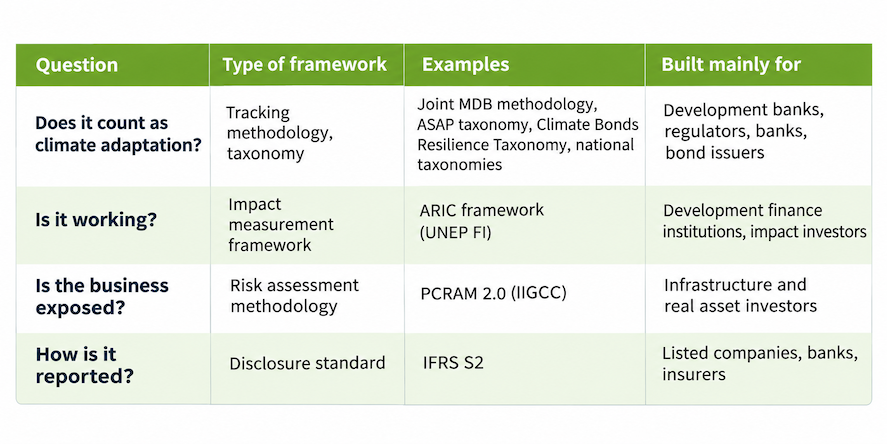
Does it count? The joint MDB methodology asks a project to set out its context of vulnerability, state an explicit intent to address it, and link its activities to that vulnerability (OPEC Fund summary). Most taxonomies follow a similar logic. The ASAP taxonomy defines what an adaptation SME offers, while the Climate Bonds Resilience Taxonomy now underpins certified resilience bonds. National taxonomies are arriving too. Rwanda’s Green Taxonomy is the first in Africa to cover agriculture and includes climate adaptation; at its launch, officials gave the example of a farmer taking a taxonomy-aligned green loan from a SACCO. The Central Bank of Kenya issued the Kenya Green Finance Taxonomy in 2025, and South Africa published the continent’s first.
Is it working? The ARIC framework, developed by development finance institutions, starts by defining how an investment’s outputs lead to climate adaptation outcomes, then sets out metrics that can be aggregated across a portfolio.
Is the business exposed? PCRAM 2.0 brings physical climate risk into the appraisal of real assets. PIDG tested it on a marine transport project in East Africa.
How is it reported? IFRS S2 is coming to the region’s financial sectors. Ghana and Nigeria make it mandatory for large entities from 2027 and 2028, and Kenya and Rwanda have adoption roadmaps. Once banks have to report on climate risk, they will ask their borrowers for the information.
What good practice looks like
No single framework closes the translation gap. The investors and enterprises making most progress tend to take three steps.
- Start with a theory of change. Mercy Corps Ventures screens every deal against a resilience thesis with four target outcomes. As our whitepaper describes, its pilots test three things at once: whether a product builds resilience, whether it fits local needs, and whether it works commercially.
- Measure what end users experience, not only reach. Acumen surveys a sample of a company’s customers before investing. Across nearly 5,000 farmers, 60 Decibels found that 68 to 86% of those whose income rose reported greater resilience, against 25 to 36% of those whose income did not change. Income and reach matter, but they are weak proxies on their own. The IFC’s Silent Adapters report adds that standard metrics miss much of the climate adaptation that smaller firms already do.
- Build it into systems, at the right level. Our whitepaper documents the Landscape Resilience Fund’s experience: a framework that worked for the fund proved too demanding for many of its SMEs. Roots of Impact took a different route in Bangladesh, training local verifiers and working with LightCastle Partners to test how each business model would hold up against a specific climate stressor. The lesson is to carry the heavier measurement at portfolio level, keep enterprise metrics light, and invest in local verification.
How PlanAdapt can help
PlanAdapt works with financial institutions and enterprises on both sides of the translation gap. We design climate adaptation frameworks: screening criteria, taxonomy alignment and outcome metrics that fit a portfolio and the businesses in it. We also offer climate adaptation reporting and operations alignment support. That means helping you build a clear climate adaptation theory of change; identify, measure and communicate your climate adaptation impact; and develop management systems and business models that serve your climate adaptation goals.
This post is the first in a series building on our CAIL whitepaper and our session on climate adaptation impact reporting at the Adaptation Investment Summit for Africa. If you want to know whether your investment is truly climate adaptation-positive, get in touch.