
Making Capacity Strengthening More Gender-Equitable and Inclusive: The GEI Checklist for Inclusive Events
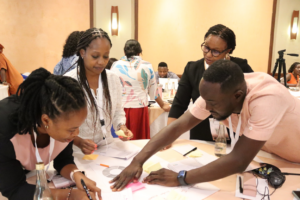
What does it actually mean to make a capacity strengthening approach more gender-equitable and inclusive in the context of adaptation and resilience?
It can be tempting to think the answer is straightforward: invite a diverse group of people, make the venue accessible, use inclusive language, and make sure everyone has an opportunity to participate. But, in practice, inclusion is rarely that simple.
A workshop can have a diverse group in the room and still leave some voices unheard. A training can be technically excellent while being difficult for people with caring responsibilities to attend. A discussion can invite community perspectives without those perspectives having any influence over what happens next.
Hence, how can capacity strengthening approaches be more gender-equitable and inclusive?
Starting with what is already happening across CLARE
Rather than beginning by asking what a perfect approach should look like, the Capacity Strengthening (CS) Hub wanted to start collecting what was already happening across the CLARE programme as part of their learning agenda.
We looked across projects to understand where gender equality and inclusion were already being considered in capacity strengthening approaches, which ones were championing more inclusive approaches, and what practices others could learn from.
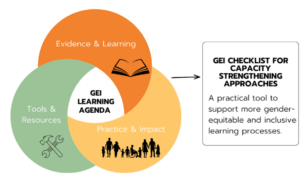
This was important because GEI does not necessarily look the same in every capacity strengthening context. A community-based training, a technical workshop, a policy dialogue and a system-level learning event may all require different approaches. GEI integration should be adapted to different project objectives and contexts rather than treated as a single prescriptive methodology.
The learning also highlighted an important opportunity. Not all capacity strengthening approaches across CLARE have been designed with GEI as an explicit focus. Rather than viewing this simply as a gap, we saw an opportunity to ask a more useful question: what would help teams recognise where inclusion could be strengthened, and what practical changes could they make?
From being aware to doing something differently
One of the lessons from CLARE’s wider GEI work is that inclusion is about more than representation.
Meaningful participation, co-production and influence are important dimensions of inclusive climate adaptation. Simply attending a consultation does not mean that people are able to participate safely, that their knowledge is valued, or that their contributions influence decisions.
This distinction matters for capacity strengthening.
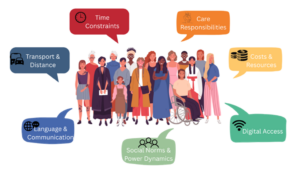
For example, recognising that parents and/or guardians may have caring responsibilities is an important first step. But a more equitable approach asks what can actually be done about that barrier: Can the timing be changed? Can childcare be supported? Could another way of participating be offered?
Likewise, recognising that participants have different levels of confidence or institutional power is only the beginning. Inclusive facilitation might mean creating smaller discussion spaces, offering different ways to contribute, or actively managing who is dominating the conversation.
The aim, therefore, is not simply to be aware of differences, but to use that awareness to make more deliberate choices.
A checklist designed for real-world use
The GEI Checklist for Capacity Strengthening Approaches was developed as a practical response to this learning question.
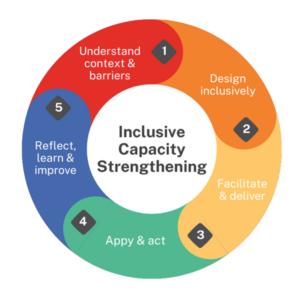
It invites organisers, designers and facilitators to reflect before, during and after an activity: Who might face barriers to participation? Are different needs and perspectives being considered? Whose knowledge is being heard? Are participants able to engage in ways that work for them? What could be done differently next time?
The checklist also deliberately recognises that not every question will apply to every activity. The current tool allows users to adapt their reflection according to the purpose, audience and format of the activity, including in-person, virtual and hybrid settings.
This flexibility is important as the intention is not to make every capacity strengthening approach explicitly about GEI, nor to suggest that there is one correct level of integration.
A learning tool, not a compliance exercise
The checklist is not intended to produce a pass or fail, hence a “Not sufficiently” response is not a negative judgement. It simply tells us that a particular consideration was not relevant to the activity, or that there is an opportunity to strengthen the approach. The checklist encourages users to review these responses, identify a feasible number of practical improvements, and carry those lessons into future activities.
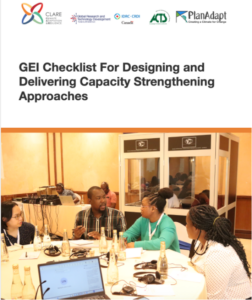 This reflects the Capacity Strengthening Hub’s broader approach: learning should lead to reflection, experimentation, and improvement.
The checklist is not intended to be the final answer to the question of how capacity strengthening can become more gender-equitable and inclusive. But it may help to ask and reflect on the following questions:
Who might be missing, what might be getting in their way, whose knowledge is shaping the learning, and what can we do differently?
Explore the CLARE GEI Checklist
Access the GEI Checklist for Capacity Strengthening Approaches here.