
Applied Research for Real-World Climate Adaptation and Risk Management
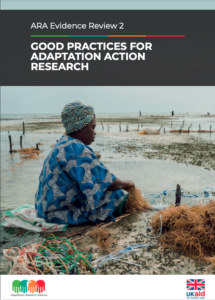 At PlanAdapt, we engage in climate adaptation and climate risk management research with a clear commitment: research must contribute directly to better decision-making, stronger institutions, and more just and resilient societies. Our research work is grounded in research approaches, schools of thought, and emerging trends that explicitly value co-creation, stakeholder involvement, learning, usability, and real-world outcomes (such as action-oriented research, participatory action research, post-normal science, research co-creation and knowledge co-production), in addition to purely academic, publication-driven research cultures. These approaches reflect the insight that adaptation is not only a technical challenge but also deeply social, political, institutional, and cultural. We design and facilitate research processes that are collaborative, inclusive, and grounded in lived experience — aligned with the principles articulated in contributions such as the review of Good Practices for Adaptation Action Research.
Research-Into-Use and Research Impact as Core Foundations
A defining feature of our research philosophy is a strong commitment to research-into-use, knowledge uptake, and research impact. We deliberately design research so that it supports real-world decision-making rather than ending as stand-alone outputs. Our work in knowledge brokering, learning facilitation, and science-policy mediation helps ensure that climate knowledge becomes meaningful across institutional contexts and is accessible to policymakers, practitioners, funders, and communities. This is reflected in our approaches described under our dedicated work on Knowledge Brokering and Research Impact, where we focus on making knowledge more usable, actionable, and influential.
We see research not as a product, but as a process — one in which knowledge is continually shaped through dialogue, reflection, iteration, and relationships.
Working Alongside Academic and Research Actors
We work closely with universities, research institutes, scientific consortia, and think tanks, acting as a bridge between rigorous academic research and practice environments. Academic partners bring disciplinary depth, quantitative and qualitative research rigor, and theoretical innovation. PlanAdapt contributes complementary strengths in applied research methodologies, co-creation design, facilitation of stakeholder engagement, translation of scientific evidence into decision contexts, and long-term accompaniment of institutions and communities.
This bridging role enables research to (a) be grounded in real institutional and societal dynamics; (b) better reflect diverse and locally embedded knowledge systems; (c) remain relevant beyond publication cycles and (d) travel effectively across policy, business, and community settings.
In many initiatives, we co-lead or support the integration of adaptation research into real-world policy processes, development initiatives, private sector frameworks, and community resilience efforts.
Supporting Researchers: Knowledge Brokering, Networking, and Capacity Strengthening
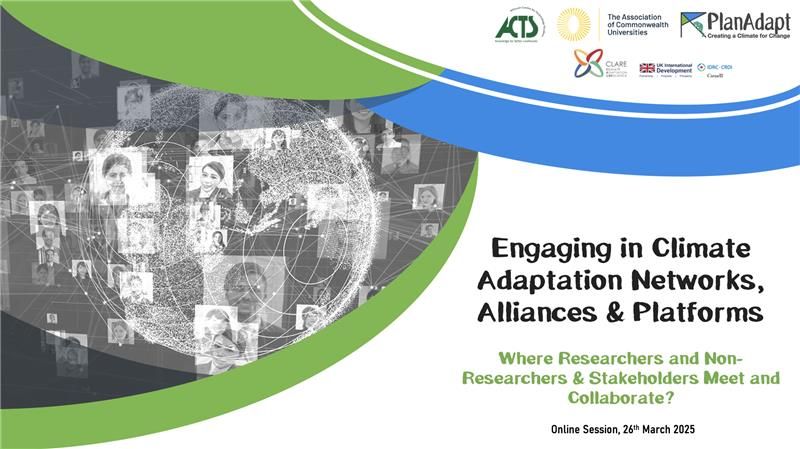
A significant share of our work focuses on supporting research initiatives themselves — strengthening their ability to deliver useful, impactful, and socially grounded adaptation knowledge. We help research programmes:
- embed knowledge brokering architectures into their design (see PlanAdapt's role in the Commonwealth Futures Climate Research Cohort 2023-24 programme)
- build networking platforms and communities of practice
- integrate capacity strengthening elements for practitioners, institutions, and early-career researchers
- design engagement and uptake strategies that go beyond dissemination
We collaborate with funders, universities, research alliances, and practitioner networks to build research ecosystems that are not only scientifically sound, but also socially embedded and practically influential.
Actively Contributing to the Global Adaptation Research Community
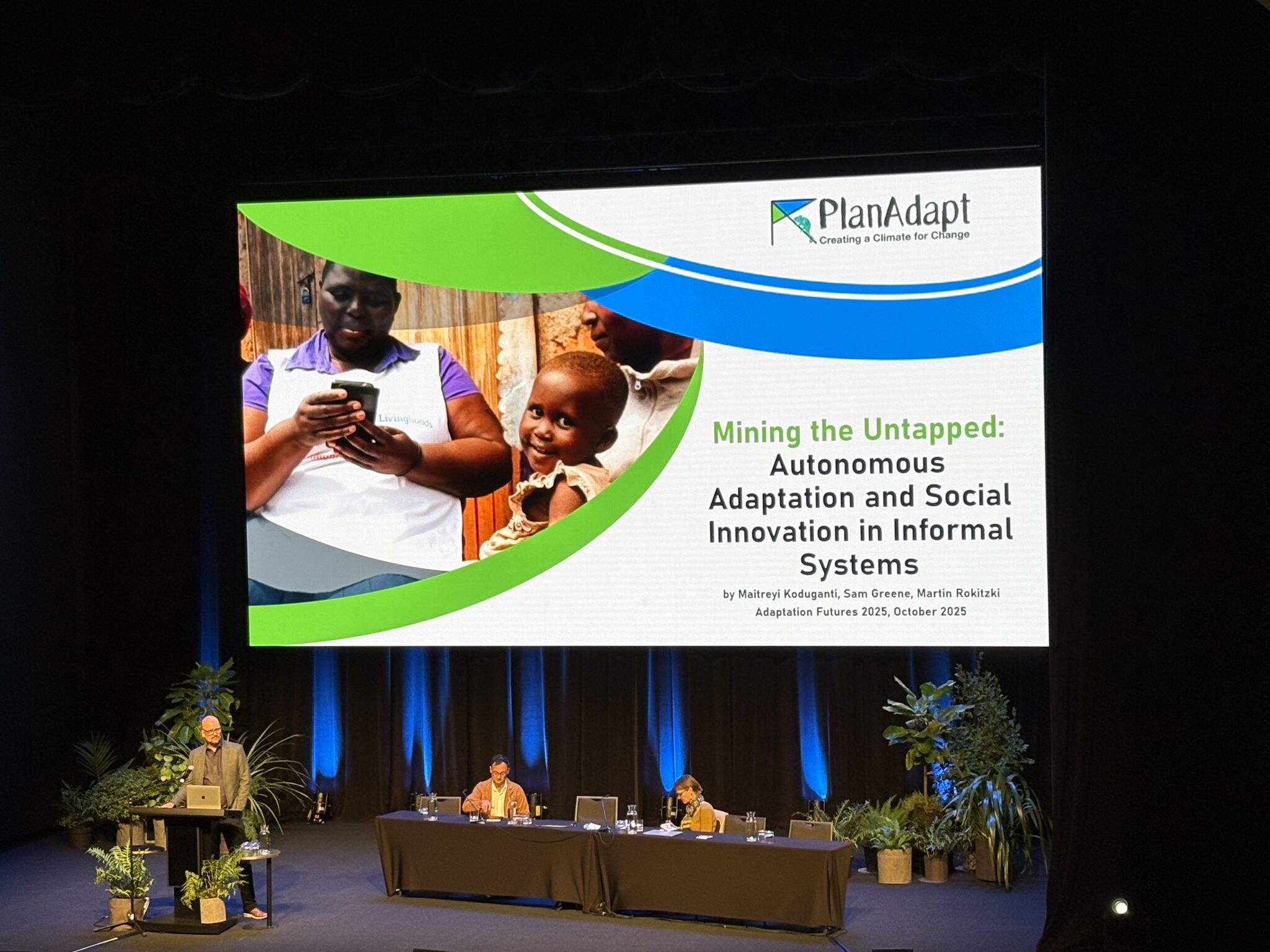
PlanAdapt is deeply engaged in the global adaptation research community and contributes through leadership, participation, and collaboration in key alliances and platforms, including:
- the Climate Adaptation and Resilience (CLARE) Programme, for which PlanAdapt co-hosts the CLARE Capacity Strengthening Hub
- the Adaptation Research Alliance (ARA) – advancing principles of action-oriented, equitable, and impact-driven adaptation research
- Adaptation Without Borders – supporting collaboration, knowledge generation, and policy engagement on transboundary and cascading climate risks
- the Adaptation Futures Conference Series – the leading global event on adaptation research and practice, where we regularly engage, share learning, and build collaborations
Through these networks and partnerships, we help shape a research ecosystem that is practice-relevant, inclusive, socially just, globally connected, and impact-driven.
Adaptation Research: Our Position in the Research Landscape Beyond Climate Impact Science
A key feature of our identity is that PlanAdapt is fundamentally rooted in climate adaptation research. We believe that understanding the difference between climate impact research and climate adaptation research is essential for effective climate action. Both are interconnected, but they serve different purposes in the pathway from understanding climate risks to implementing solutions.
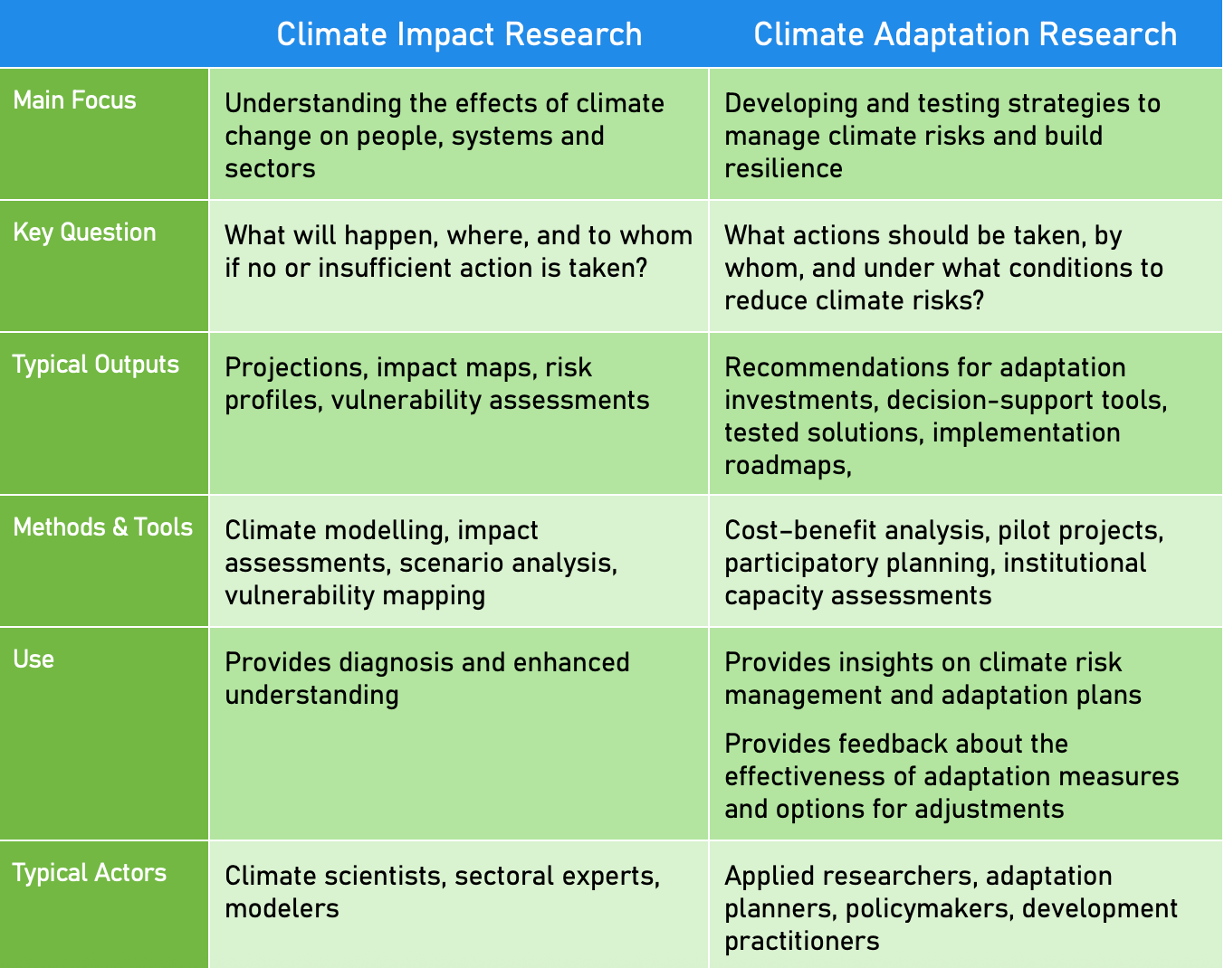 Climate impact research focuses primarily on understanding how climate change affects physical systems, ecological processes, economies, and societies. It often includes climate modelling, impact projections, vulnerability analyses, biophysical assessments, and quantitative risk estimations. Much of this work is conducted within academic and scientific institutions and synthesised in global assessments such as the IPCC Assessment Reports – Working Group II on Impacts, Adaptation and Vulnerability. Whereas climate adaptation research, where PlanAdapt positions itself, is concerned with how societies can respond to these impacts: how decisions are made, how institutions evolve, how policies are designed, how behavioural and social change happens, and how adaptation actions can be effective, fair, context-appropriate, and sustained. Adaptation research addresses governance, power, justice, learning, policy processes, finance mechanisms, adaptation pathways, and implementation challenges. It is inherently applied, transdisciplinary, and strongly embedded in practice — as increasingly reflected in scholarly communities such as the Adaptation Futures or Adaptation Research Alliance network and collaborative initiatives like Adaptation Without Borders.
PlanAdapt actively contributes to advancing adaptation research and practice, while regularly working alongside climate impact science actors — universities, modelling institutions, think tanks, and research consortia. Where climate impact science generates essential evidence on “what is happening” or “what will likely happen”, our work helps translate this into “what to do with this knowledge”, “who needs to act”, “how decisions change”, and “how systems can adapt effectively and equitably.” We therefore complement impact science by embedding it into decision processes, governance structures, social learning environments, and institutional transformations.
Across all our research engagements, our guiding principle remains constant: climate adaptation research must empower decision-makers, strengthen communities, support institutional change, and advance climate justice. We therefore treat research not as an end in itself, but as a means to enable real-world transformation and resilient futures.
Please find a selection of key reports and flagship publications resulting from research with significant contributions and authorship by members of our team.