
Beyond Heat Action Plans: What Are People Already Doing to Adapt?
Why autonomous heat adaptation deserves a place in how we plan for heat
Across South and Southeast Asia, heat is heard before it is measured. It is in the whirr of coolers and fans by mid-morning, in shutters coming down at noon, in markets that empty in the afternoon and fill again at dusk. Long before an alert is issued or a plan is activated, people have already changed how they work, sleep, cook, travel and care for one another.
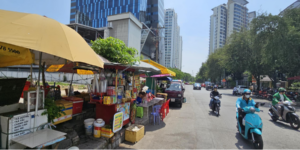
This is autonomous adaptation: people responding to heat without waiting for a formal intervention. Most of it is never labelled as adaptation. It does not appear in a city strategy, a project document or a monitoring framework. Yet it shapes who is exposed to heat, for how long, and what they can do about it.
Heat action planning has been a genuine step forward, and we are not arguing otherwise. But plans, early warnings and cooling centres describe what institutions do about heat. They tell us much less about what people are already doing, and what it costs them.
Heat is landing on the informal city
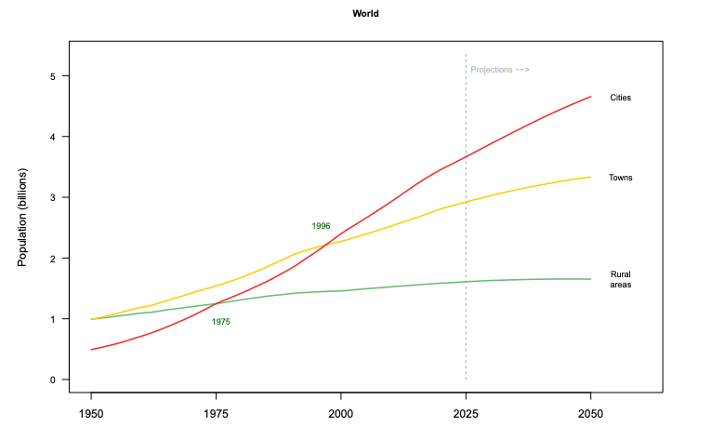
Cities are now home to about 45% of the world's 8.2 billion people, according to the UN's World Urbanization Prospects 2025, and two-thirds of population growth to 2050 is projected to happen in cities. In much of Asia and Africa, that growth is informal. More than 1.1 billion people already live in slums or informal settlements (UN-Habitat), and Satterthwaite and colleagues warn that without more effective policy, most of the growth in the urban population will be accommodated in informal settlements. The IPCC reaches the same conclusion from the risk side. Its Sixth Assessment Report chapter on cities finds that urban vulnerability and exposure are growing fastest where adaptive capacity is limited, especially in unplanned and informal settlements in low- and middle-income countries, and that most people exposed to heatwaves will live in urban centres.
Heat meets this city at every point, and informal settlements are dense and short of the infrastructure needed to cope with heatwaves. The ILO estimates that more than 2.4 billion workers, about 71% of the global workforce, are likely to be exposed to excessive heat at some point in their work, and the countries most affected tend to have higher rates of working poverty and informal employment. The 2025 Lancet Countdown puts heat-related deaths at around 546,000 a year, and the World Bank's A Livable Future estimates that extreme heat costs South Asia the equivalent of nearly 31 million full-time jobs each year. In Karachi, informal settlements cover around nine per cent of urban land but house about 62% of residents, according to research by Anwar and colleagues discussed in IJURR's extreme heat series. Anwar's introduction to that series describes a "thermal penalty" on the inhabitants of South Asian cities.
This is why heat cannot be contained within a conventional heat response. It runs through housing, work, energy, water and care, and much of that sits in informal systems that plans rarely see. The 2026 special issue of Urbanisation on informality and climate change in cities of the Global South, treats informality as a defining part of how cities grow, not something waiting to be formalised, and sees opportunity where informal and formal governance connect. That is the territory autonomous adaptation lives in.
People are adapting, and paying for it
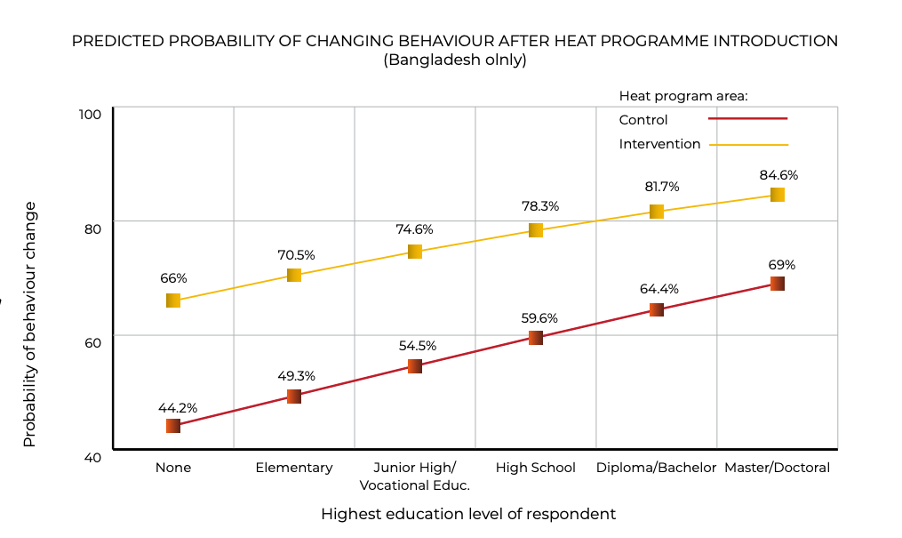
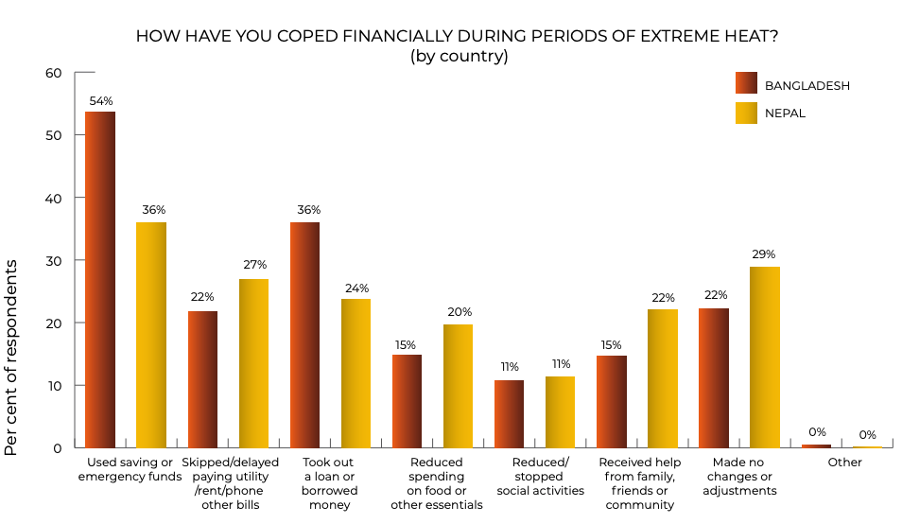
Those choices are rarely free, and they are not equally available. A household that stays indoors at midday lowers its exposure, but if it depends on daily wages, it also loses the day's income. A worker who moves their hours away from the worst heat loses productive time. Cooling reduces thermal stress but needs money and a reliable electricity supply. A caregiver who protects someone else from heat takes on unpaid work to do it.
Not all these costs are monetary. Adapting to heat takes time, effort and attention, and the burden is shared unevenly. Women and girls often carry much
of it: fetching and storing more water, cooking in hot kitchens, and caring for children, older relatives and the sick, often on top of paid work. Sleeping badly in a hot home, working through dangerous heat to protect an income, and living with constant worry about the next heatwave also take a toll on mental health and wellbeing that no household budget records.
Each of these is a response to heat, but they do not reduce vulnerability in the same way, and they do not cost the same. An action can be adaptive and still carry costs, and those costs fall on the people with the fewest resources to absorb them.
Formal systems see interventions, not adaptation
Formal adaptation systems look for what can be identified, funded, implemented and measured. That is understandable, since institutions have to allocate resources and judge impact. But it means a market changing its hours in a heatwave, a family reworking how it ventilates or sleeps, or an informal worker moving a shift is rarely recorded as adaptation.
This is the question at the centre of PlanAdapt's Mining the Untapped: Why Climate Adaptation Must Look Beyond Formal Systems: what does adaptation practice miss when it overlooks the informal systems through which people organise livelihoods, manage risk and innovate under pressure? Heat makes that question urgent.
None of this means autonomous responses are effective, equitable or scalable by default. It does mean that we cannot decide what institutions should support until we understand what people are already doing, who can do it, and who cannot.
There is no single experience of heat
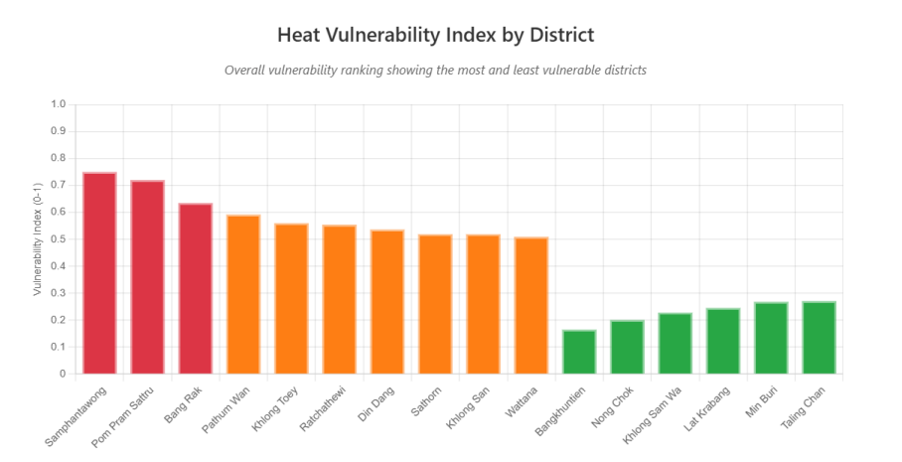
A 2026 Scientific Reports study of 15 South Asian cities finds substantial differences in heat resilience even within one region. Bangladesh and Nepal combine climate, housing and livelihoods differently. India's cities vary enormously in infrastructure, occupation and access to cooling. Bangkok has its own conditions, shaped by humidity, land use and rapid development, which the Asian Disaster Preparedness Center's Urban Heat Resilience work in Bangkok and southern Vietnam sets out through modelling, vulnerability analysis and spatial assessment.
If adaptation emerges from a particular mix of climate, housing, work and social relations, then copying an intervention into a new place does not copy its effects. What needs to scale is not always the solution. It is the capacity to identify, test, learn from and support the right responses in each context.
What formal systems might learn
The question is not whether formal systems are necessary. They are. A forecast can say when heat is coming, and a plan can assign responsibility. Neither tells us which workers cannot afford to stop, which homes stay dangerously hot at night, where people go for relief, or who carries the work of protecting others.
Governance thinking is starting to close these gaps. In a 2026 Nature India interview, Vishwas Chitale argues for systems, not reactions, with longer-term links between forecasting, health systems, worker protection, equitable cooling and governance.
The task is not to choose between formal systems and local responses but to work out how they can meet. That means supporting people's agency without taking it over, drawing on local knowledge without extracting or flattening it, and easing some of the costs people are absorbing alone. It also means asking a hard question of any adaptation, ours included: is it reducing vulnerability, or only moving its costs somewhere else, and onto whom?
What we are developing: autonomous heat adaptation
Mining the Untapped argued that adaptation must look beyond formal systems. Autonomous heat adaptation is where we are working that out in practice.
In developing this work, we try to understand what people are already doing about heat, what those responses cost, who bears those costs, and what institutions can do to support them without taking them over.
We are not romanticising informal adaptation, suggesting people should cope alone with extreme heat, or trying to replace public investment with individual responsibility. Recognising what people already do, and the price they pay for it, should be the starting point of every heat solution we propose.
Heat adaptation does not start from zero. People are already responding to a hotter world. The task is to make those responses visible, and to ask what formal systems should do differently as a result.
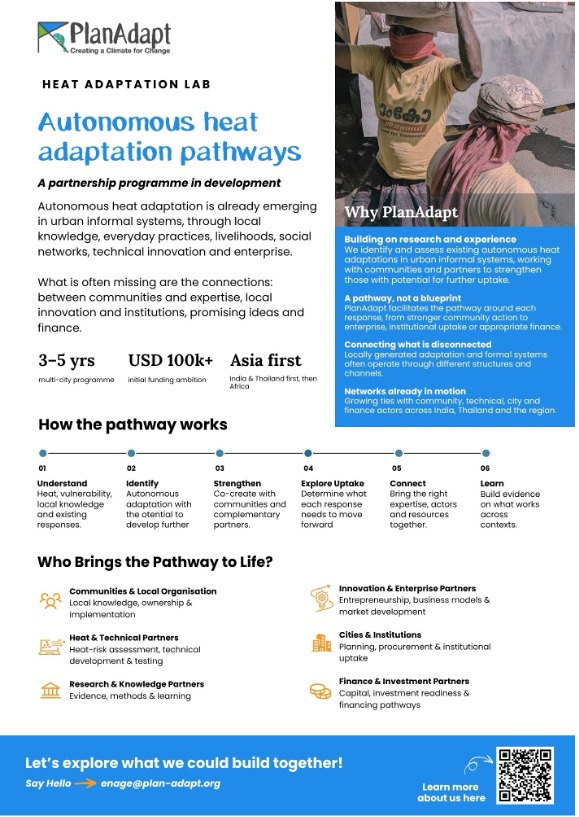
We are beginning to develop a PlanAdapt Heat Adaptation Lab to explore how people are already responding to urban heat, what these responses reveal about vulnerability and agency, and what it would take to support them without losing their local specificity.
We are interested in working with researchers, practitioners, communities, public institutions, funders and others who are asking similar questions: What can we learn from adaptation that is already happening? What does it cost? And how might formal systems, finance and local actors work differently as a result?
The Lab is currently at the concept stage, and we are looking to build the questions, partnerships and pathways together.