
Beyond the Workshop: Equipping People to Better Adapt to Climate Change
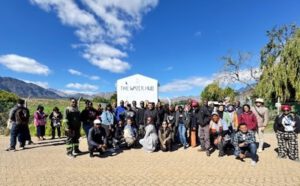
Capacity strengthening is everywhere in climate adaptation work. It appears in project proposals, logframes and strategies. It is often attached to familiar activities: workshops, trainings, toolkits, mentoring and peer learning.
These activities matter. But capacity strengthening goes beyond one-off activities.
At PlanAdapt, through our work with the CLARE Capacity Strengthening Hub and wider climate adaptation learning processes over the last seven years, we see capacity strengthening as something more strategic, long-term and systematic: a way of enabling people, organisations and systems to act in conditions of uncertainty, complexity and change.
The real test is not whether a workshop happened. It is whether people are better able to use knowledge, navigate constraints, influence decisions and shape climate adaptation action.
Capacity can’t be handed over
One of the most persistent assumptions in capacity strengthening is that capacity can be transferred: from expert to learner, from toolkit to practice, from training room to workplace. However, learning starts with the individual, which is why we need to put the learners at the centre. Learning happens throughout a process: through conversations, relationships, experience and reflection, as well as through more formal training.
Ideas introduced in theory need to be tested, adapted, and applied in practice. But climate adaptation rarely works exactly as learned in theory or as it has worked elsewhere. Climate adaptation is shaped by politics, institutions, resources, relationships, incentives, and power. Capacity is therefore not only about what people know. It is about what they are able to do with what they know.
That depends on the learner’s confidence, trust, networks, leadership, organisational support, access to resources, and the ability to influence decisions. It also depends on whether existing capacities are recognised and valued.
For PlanAdapt, capacity strengthening is not delivery. It is an enabling process for people and organisations.
Stop asking only, ‘what training do we need?’
Instead, ask: Capacity for what? For whom? According to whom? And how?
These questions move capacity strengthening beyond generic skills and deficit-based thinking. They ask what change capacity strengthening is meant to support, whose priorities shape it, and who has the agency to act.
Capacity does not sit in one place. It exists across people, organisations and systems (Porzecanski et al. (2022):
- People need skills, confidence, agency, and relationships to interpret information and make decisions.
- Organisations need leadership, incentives, resources, and cultures that support learning.
- Systems need policies, funding arrangements, and power structures that enable climate adaptation action.
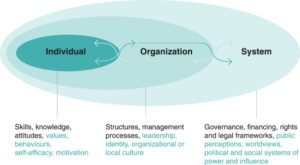
Strengthening one level while ignoring the others rarely works. People may gain skills but lack permission to use them. Organisations may want to support climate adaptation but face rigid reporting requirements. Systems may call for transformation while underinvesting in the people and relationships needed to sustain it.
Workshops can spark change. They cannot carry it.
A stronger approach to capacity strengthening does not abandon workshops or trainings. It puts them in their proper place: inside a longer-term process.
That means paying attention to what happens before, during and after a learning activity. It means building trust, supporting peer learning, creating opportunities to apply learning, recognising existing capacities, and tracking change beyond attendance numbers.
It also means taking power, gender equality and inclusion seriously: who participates, whose knowledge counts, and who is able to influence decisions.
Counting rarely captures what matters
If we only count workshops, participants and tools, we miss much of the change that capacity strengthening is meant to support.
We also risk designing for what is easy to report, rather than what is needed for climate adaptation.
If we want to understand the change that happened through capacity strengthening, we should focus on understanding changes in confidence, relationships, agency, influence, organisational practice, and the conditions that make climate adaptation action possible.
Climate adaptation needs more than information
Climate adaptation requires people and institutions to do more than access information. They need to be able to make sense of uncertainty, work across disciplines and sectors, bring different forms of knowledge together, navigate competing priorities, and translate evidence into decisions suited to particular places and contexts.
These capacities combine knowledge with judgement, relationships, and agency. They develop through practice and depend on organisational and systemic conditions that allow people to use them.
Later in this series, we will look more closely at the research, research-for-impact and adaptation-specific capacities that climate adaptation work demands. We will also explore how capacity strengthening can be designed, supported and evaluated in ways that move beyond activities – and towards meaningful, equitable and lasting change.
Further reading
Brinkerhoff, D.W. & Morgan, P. (2010). Capacity and capacity development: Coping with complexity. Public Administration and Development, 30(1), 2–10. https://doi.org/10.1002/pad.559
Morgan, P. (2006). The Concept of Capacity. European Center for Development Policy Management. https://ecdpm.org/application/files/3616/5547/2779/2006-The-Concept-of-Capacity.pdf
Ensor, J. & Harvey, B. (2015). Social learning and climate change adaptation: evidence for international development practice. WIREs Climate Change, 6(5), 509–522. https://doi.org/10.1002/wcc.348
Rokitzki, M. & Hofemeier, A. (2021). Unleashing the Potential of Capacity Development for Climate Action. PlanAdapt. https://www.plan-adapt.org/2021/09/02/unleashing-the-potential-of-capacity-development-for-climate-action/
Singh, C. et al. (2022). Interrogating “effectiveness” in climate change adaptation: 11 guiding principles for adaptation research and practice. Climate and Development, 14(7), 650–664. https://doi.org/10.1080/17565529.2021.1964937