Adaptation Knowledge and Innovation Brokering
Enabling Co-Creation, Use and Access to Relevant Data and Information - Facilitating Sense-Making for Enhanced Adaptation Decision-Making
Effective climate action in the 21st century relies on decisions fully informed by the best available climate knowledge. As a result, a somewhat new breed of professionals has developed – climate knowledge and innovation brokers (CDKN 2023, Scodanibbio et al. 2023, Gholasany & Havey 2023).
All PlanAdapt team members are climate adaptation knowledge and innovation brokers in their specific field of expertise and themes. We work with others (e.g., early-career climate researchers of the ACU Climate Cohort 2023-24, CLARE-funded climate adaptation researchers) to affect changes in the agency and actions (Dablander et al. 2024) of decision-makers and ‘agents of change’ in the respective countries and sectors, to ensure that they are informed by the latest and most relevant research outputs. Knowledge brokering has a lot of other labels and overlaps with similar sets of activities and approaches, such as Research-Into-Use, Research To Action, Knowledge Into Action, Knowledge Mobilisation, Research Impact (Belcher et al. 2021), Research for Impact (Rawden et al. 2024) or Climate Services.
Adaptation Knowledge Brokering - A Set of Processes, Methods, and Tools to Facilitate the Co-Production of Tailored and Actionable Climate Services
Despite significant advancements in scientific research around the drivers of climate risk, effective adaptation action in the Global South has been hindered by a misalignment between the production of expert climate knowledge and the information needs of decision-makers in practice (IISD 2019, Vincent et al., 2018; Kirchhoff et al., 2013). In particular, the disconnect between scientific, top-down approaches to knowledge production and the institutional and cultural contexts where adaptation decision-making takes place has been regularly cited as a significant barrier to the useability and uptake of climate knowledge (Harvey et al., 2021, Wyborn et al., 2019).
The failure of climate research to spur the levels of action needed to effectively reduce and manage risks has turned attention to the emerging field of boundary work, and the role that knowledge brokers can play in improving the useability and impact of climate research (Bremer and Meisch, 2017, Daniels et al., 2020, Coninx 2023). Acting as intermediaries between the producers and users of information, knowledge brokers seek to facilitate the integration of a plurality of knowledge systems across regions, institutions and stakeholders at the interface of climate science and policy-making.
Making Sense of Climate Information is a Process Based on Trust, Relations and Contextual Understanding
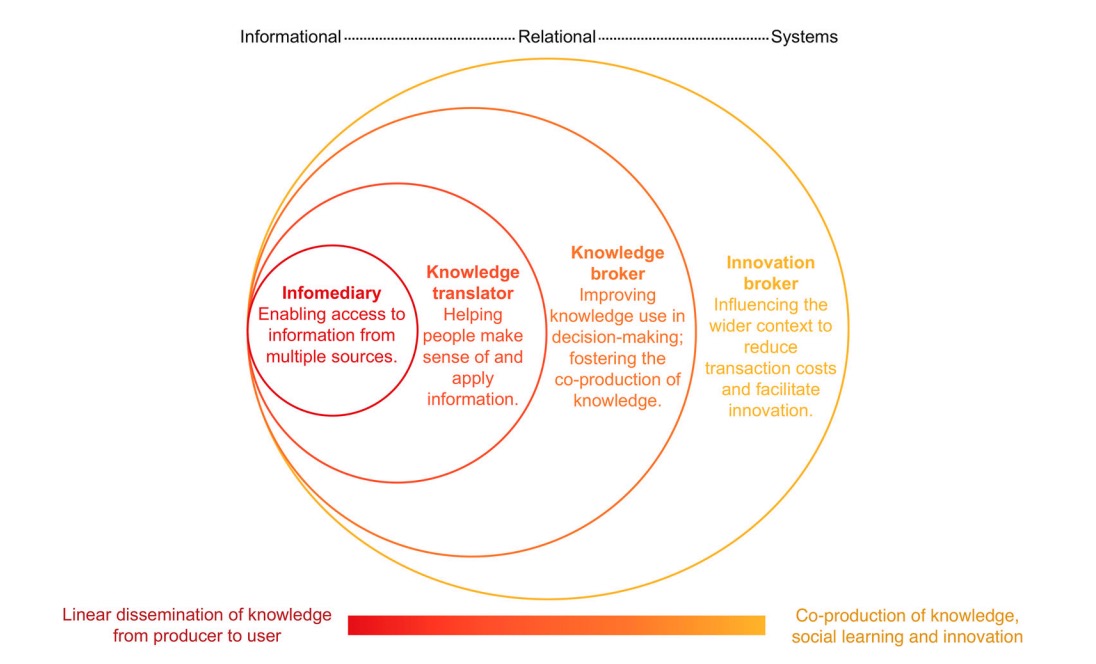
Over the last 10 years knowledge brokering has made a significant impact in supporting effective decision-making and enabling adaptation action, leading to improved outcomes for disaster risk reduction and sustainable land management initiatives to name a few (Cummings et al., 2018). Moreover, it has been recognised that by facilitating dynamic processes of collaboration between stakeholders and institutions, integrating marginalised knowledge systems, and promoting mutual learning, boundary work has served an important role in developing the capacity of institutions and vulnerable communities to adapt to, mitigate and manage climate risks.
Adaptation Knowledge and Innovation Brokers Enable Inclusive, Participatory, and Context-Based Adaptation Solutions
The increasing relevance of boundary work and knowledge brokering (Bremer et al., 2019) reflects a growing awareness that solving ‘wicked’ problems, such as climate adaptation, requires participatory processes that integrate local knowledge systems and multiple stakeholders across sectors (Hoppe et al., 2017). Within this fifth generation there is a clear emphasis on the importance of both the process of knowledge brokering as well as the production of climate services (Harvey et al., 2021), and guidelines such as the ‘The Climate Knowledge Broker’s Manifesto’ have highlighted that for boundary work to bring about long-term and transformational change, the processes, tools, and methods operationalised by brokers must be inclusive, participatory, and context-based. This requires taking into consideration whose knowledge is being empowered, for whose benefit, and whether this is representative of both the decision-making context and the plurality of stakeholders affected (Wyborn et al., 2019).
Adaptation Learning Spaces are Vital and Should Be Based on Effective Monitoring
One key gap consistently identified in the practice of boundary work is the use of effective processes for long-term monitoring and evaluation (Vaughan et al., 2018). A variety of evaluation criteria for boundary work exists, split predominantly between those which focus on the improved useability of climate information, and those which focus on the intangible benefits of boundary work such as capacity development, which have arisen from the process of itself. For knowledge brokers to ensure that these processes lead to effective decision-making and adaptation action, more emphasis must be placed on the development of feedback-loops, critical reflection around processes of stakeholder engagement, and the maintenance of long-term and dynamic collaborations between the producers and users of climate knowledge (Alexander and Dessai, 2019).
At PlanAdapt, we constantly experiment with new ways of collective learning, social learning (Colloff 2025), or co-learning systems (GIZ 2020) in the societal spaces that require decision-making and action towards positive climate adaptation. The Climate Co-Adaptation Lab is an example that supports and enables adaptation knowledge and innovation brokers to foster, create and facilitate these adaptation learning spaces wherever they are appropriate and deemed necessary.
Online courses focusing on knowledge brokering tools, processes and case studies:
- Knowledge Broker Support Program (KBSP) online course by Commonwealth Scientific and Industrial Research Organisation (CSIRO)
- Integrating Climate Risk Information into NAPs by UN Climate Change Learning Partnership (UN CC:Learn)
- MOOC Research for Impact (University of Cape Town)