

Enabling Researchers and Users of Research Findings to Enhance Climate Adaptation Strategies and Policies and Innovate for Impactful Adaptation Solutions
Overview
The Capacity Strengthening Hub (July 2023 - December 2026) supports the CLARE Programme in its objective to strengthen capacity from research to action for climate-resilient development. Hosted by the African Centre for Technology Studies (ACTS) and PlanAdapt, the Hub works closely with CLARE projects to strengthen capacity in climate change adaptation and resilience research across individuals, organisations and networks.

Drawing on PlanAdapt’s experience working at the interface of research, policy and practice, the Hub provides tailored and demand-based virtual and in-person support for researchers, practitioners and project staff through trainings, facilitation and advisory services.
Why Capacity Strengthening Matters in CLARE
CLARE recognises that strengthening climate resilience requires more than generating high-quality research. It also depends on the capacities of people and institutions to design, implement, communicate and use research in ways that support inclusive and effective climate adaptation.
The Capacity Strengthening Hub contributes to this ambition by supporting locally led research-to-action initiatives and by strengthening the skills, competencies, attitudes, behaviours, and institutional practices needed to translate research into meaningful impact.
What We Do
The Capacity Strengthening Hub offers support to a range of actors, particularly CLARE-funded researchers and practitioners spanning across different career levels. Overall, the Hub focuses on capacities that enhance the quality and the relevance of research and research-for-impact capacities that enhance the frequency of use and the (scale of) influence of research findings, more precisely, the CS Hub:
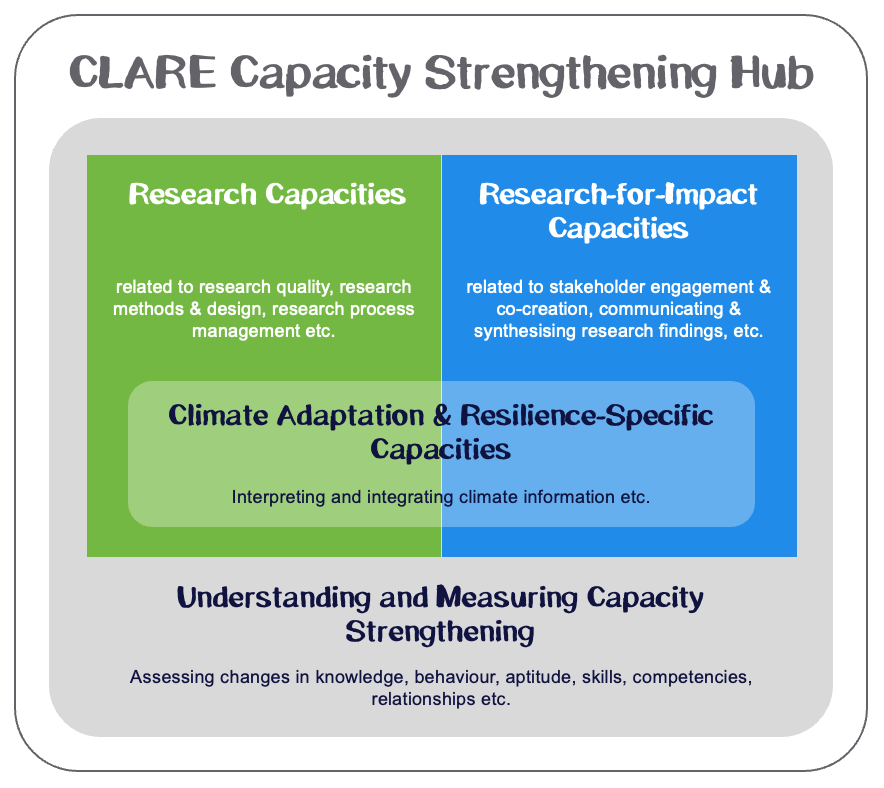
- Coordinates, co-designs and implements capacity strengthening activities through a variety of modalities and learning methods such as trainings and peer learning sessions
- Supports and advises projects on enhancing capacity strengthening quality and impact
- Summarises learnings on enablers and barriers of innovative capacity strengthening approaches
- Connects and convenes colleagues on capacity strengthening topics
How We Work
The Hub works in close collaboration with CLARE projects and partners, responding to project-identified needs and priorities. Activities are designed to be practical, participatory and reflective, and are delivered through both virtual and in-person formats. PlanAdapt contributes to the Hub through its experience supporting evidence-informed decision-making, facilitating learning across disciplines and sectors, and strengthening connections between research, policy and practice in climate adaptation. Find out more about our work on the CLARE programme website.

Role within the CLARE Programme
As part of the wider CLARE ecosystem, the Capacity Strengthening Hub complements other programme mechanisms by focusing specifically on building the capacities and conditions needed for research to be used. Through this role, the Hub supports CLARE’s broader objective of enabling locally-led, inclusive and impactful climate adaptation and resilience research.
PlanAdapt's Team
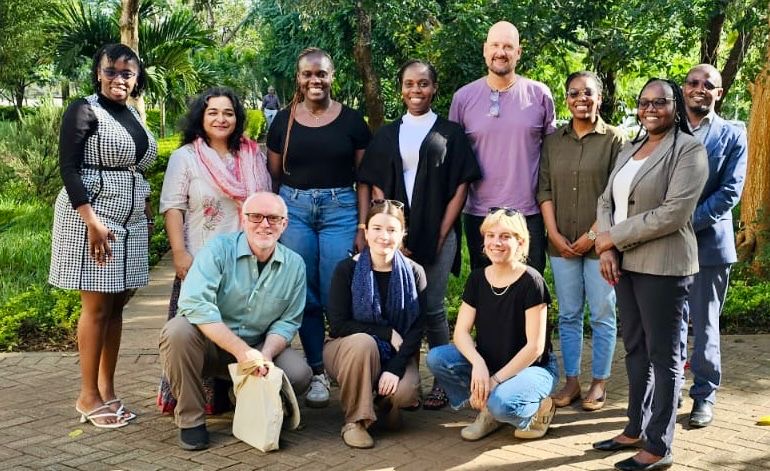
PlanAdapt’s team is composed of Alannah Hofemeier, Martin Rokitzki, Sumetee Pahwa Gajjar, Carys Richards, Biplav Pradhan, Tamara Nyirenda, Lisa Manya and Phuu Thit Kyaw, with early support provided by Catherine Fisher.
We are excited to bring our vast experience across various capacity-strengthening and research-for-impact initiatives to the table:
- PlanAdapt's experience in supporting organisations to assess, mainstream and strengthen organisational capacities in relation to climate adaptation
- Testing and proof-of-concept stages of innovation and collaboration spaces gathering adaptation researchers, experts, advisors from the Global South and North etc., i.e. Climate Co-Adaptation Lab, ultimately strengthen capacities of knowledge brokers in the area of climate adaptation, insights by learners / Fellows that includes the ability to mobilize operational ability in Africa and Asia-Pacific
- Expertise as Co-PIs and other lead roles of PlanAdapt team members in the predecessor of the CLARE Programme, i.e. the IDRC and DFID/ FCDO-funded ASSAR programme (including strategic and intellectual leadership for research-into-use component)
- Strengthening knowledge broker intelligence of early career researchers from the Global South (part of climate cohort programme), in collaboration with several UK universities and ACU.
- Methodological and analytical reflections on shortcomings of previous CS activities/ approachespromoted and implemented in the field of international cooperation and climate research and action.
- Evidence reviews on how capacity strengthening is an integral part of research-for-impact approaches in action-oriented adaptation research