
Growing Businesses for Climate Adaptation: Why Better Ecosystems Matter for LDCs and SIDS
For a long time, climate adaptation had been framed as a responsibility of the public sector. This is rapidly shifting in recent years. The private sector is beginning to recognize that adaptation and resilience are not just humanitarian imperatives but also strategic business opportunities. Every $1 invested in adaptation can generate $4-10 in benefits, with median economic internal rates of return around 25%. The global adaptation and resilience market could reach $1.3 trillion by 2030. Adaptation is emerging as an important growth frontier.
Global adaptation finance remains deeply inadequate, particularly for the Least Developed Countries (LDCs) and Small Island Developing States (SIDS). Current estimates reveal that the adaptation finance needs of developing countries by 2035 are at least 12 times as much as current international public adaptation finance flows. Adaptation and resilience accounted for just 5% of total public climate finance in 2022. The gap between urgent needs and available resources keeps widening.
A fundamental tension persists, however. This tension becomes clear when looking at nature‑based solutions such as mangrove restoration (IISD 2023). Restoring mangrove forests provides vital public goods: protection against storm surges, reduced flooding risks, and wider ecosystem benefits such as increased fish production and aquaculture incomes. Yet while the economic value of these outcomes is undeniable, they are difficult to monetize. This creates a structural dilemma: adaptation generates broad social returns but limited direct revenue streams, making it unattractive to conventional private investors unless blended finance or public support mechanisms are in place.
This tension sits at the heart of our latest work with ClimateKIC's Climate Adaptation Innovation and Learning (CAIL) facility, where we are developing a whitepaper titled Growing Businesses for Climate Adaptation: Guidance for Entrepreneurship Support Ecosystems in Emerging Markets. The project builds on a global Community of Practice on MSME Incubation and Acceleration, convened since 2024 under the CAIL project, financed by the Global Environment Facility (GEF) and implemented by UNIDO in collaboration with Climate KIC, the Global Adaptation and Resilience Investment Working Group (GARI), and UNEP FI.
Our work is guided by a central question: how can we build better incubators and accelerators that truly meet the needs of adaptation and resilience (A&R) innovators in LDCs and SIDS? We explore this through three lenses: building stronger innovation ecosystems; deploying blended finance to overcome systemic barriers; and designing scalable programmes rooted in local contexts.
What Counts as Innovation for A&R?
Innovation in A&R is broader than technology. It encompasses new products, practices, processes, services, and business models. Innovations span across a specturm from (a) market-focused innovations; they create new markets, reduce costs, or ensure compliance and soical innovations; on the other hand; they generate innovation that lies outside the strict sphere of the market, such as in cultural, juridical, ideological, or political dimensions. Here, outcomes include public goods such as reduced environmental damage, greater climate resilience, and more equitable enabling environments. These benefits are harder to monetise, and often difficult to integrate into conventional accounting systems.
In this sense, Adaptation and Resilience is positioned between public and private spheres, with outcomes of innovation spanning both sides of the spectrum. A&R innovation in LDCs and SIDS requires a framing shift from technology-driven to community-centric models. Frugality, empathy, and rootedness in local knowledge are as much markers and drivers of innovation as standard indicators. Integrating indigenous and local knowledge is not merely a matter of cultural sensitivity. It is a prerequisite for effective and scalable A&R solutions.
Building Strong and Coherent Innovation Ecosystems
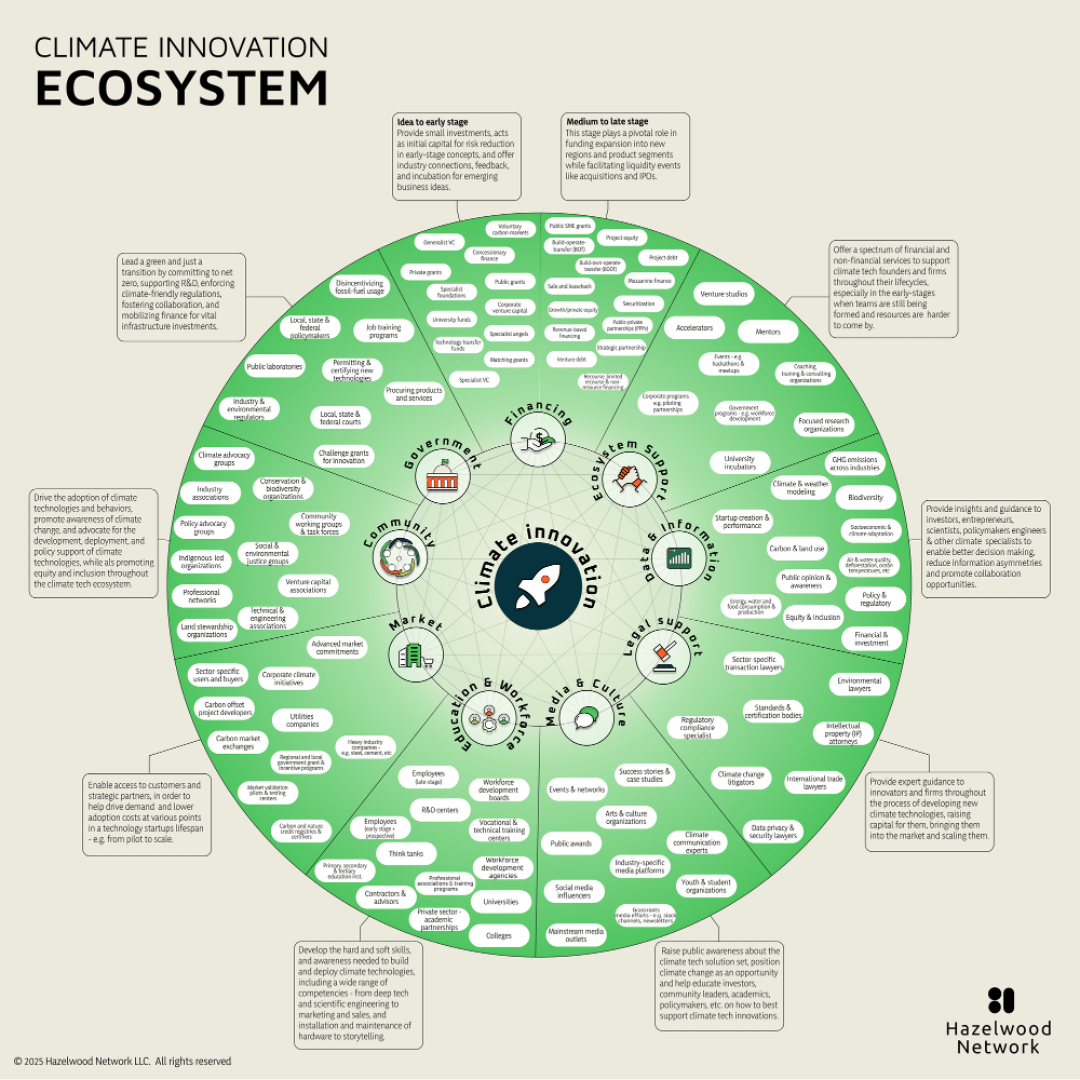
Strong A&R ecosystems rest on interlocking structural, relational, governance, and cultural dimensions. Structurally, access to finance is fundamental. Physical infrastructure, digital platforms, and hybrid governance frameworks linking government, industry, and academia are essential enabling conditions. Relationally, trust and knowledge-sharing norms shape performance. Network density alone proves insufficient without systemic integration that activates genuine pathways for capital and market access.
Various approaches specific to A&R have emerged, focusing on building strong ecosystems. For example, innovation systems approaches are built on a foundation of knowledge and learning, and evolving demand. In agriculture, for example, uptake of drought‑resilient crops depends on both upstream dissemination and downstream market access, while new institutions can strengthen collaboration. The Quintuple Helix model extends earlier frameworks by adding the natural environment and social ecology to the traditional university‑industry‑government triad, alongside civil society and media. Complementing this, the Living Lab approach defines innovation ecosystems as user‑centered, territorially embedded, and multi‑stakeholder partnerships that integrate research and practice. For climate adaptation, Living Labs provide real‑world platforms where communities, governments, researchers, businesses, and NGOs co‑design, test, and scale solutions, often drawing on helix frameworks to embed innovation in local contexts.
Intermediaries play a distinctive role within these ecosystems. They are boundary-spanning actors, positioned between macro policy and micro implementation, translating across languages, power structures, and worldviews. Their effectiveness lies not in resolving tensions but in holding them. Competing demands between funder accountability and community autonomy, between speed and inclusion, and between financial returns and social value are not contradictions to be resolved. They are dynamic tensions that, when skillfully navigated, drive systemic learning and adaptation.
Deploying Blended Finance to Overcome Systemic Barriers
Entrepreneurs in LDCs and SIDS face compounding barriers across finance, governance, infrastructure, and markets. Women and minority entrepreneurs are particularly excluded, facing structural discrimination in asset ownership, collateral requirements, and credit access (Gannon et al., 2022).
However, several blended and innovative financial instruments show stronger performance for MSMEs in climate adaptation: guarantee facilities, technical assistance-linked lending, parametric microinsurance, and challenge funds. Yet overall reach remains limited. MSMEs are too large for microfinance but too small for capital markets. This persistent 'missing middle' problem, combined with high transaction costs relative to ticket sizes, makes MSME lending unattractive to commercial investors (Bendell et al., 2007). The IFC estimates an MSME finance gap of over $1.5 billion across Pacific SIDS alone (Huber et al., n.d.).
Accelerate Prosperity, backed by the Aga Khan Development Network, illustrates what is possible when blended finance is deployed with patient capital and capability support. Operating across four countries in Central and South Asia, it has deployed USD 15.34 million, leveraged USD 53.53 million in follow-on capital, and created nearly 8,000 jobs. The model demonstrates that capital paired with investment-readiness support, coaching, and market linkages can bridge ventures toward bankability in challenging markets.
Designing Scalable Programmes Rooted in Local Contexts
New models are emerging to bridge systemic gaps. Regulatory sandboxes reduce uncertainty by allowing ventures to test innovative products and services before full-scale regulation. They enable regulators to learn alongside innovators and build evidence for permanent frameworks. Venture studios act as institutional co-founders, building companies from idea to operational stage and remaining engaged well beyond the MVP. Studio-backed ventures raise follow-on funding at roughly double the rate of incubator or accelerator graduates, with faster timelines and larger rounds.
Pyramidia Ventures, a Nairobi-based AgriFood venture studio operating across East Africa, exemplifies this approach. Rather than starting with founder applications, it starts with ideas. Opportunities are pressure-tested using deep sector knowledge before operators and co-founders are recruited into validated concepts. This directly addresses the most common early-stage failure mode: founder-market mismatch. External funding only enters once traction is demonstrated. The spin-off phase is not a handover but a continued partnership.
Across these models, a common thread emerges: locally rooted scaling requires integrated systems-level thinking. Coordination failures, fragmented service delivery, inaccessible policy processes, and exclusionary financing criteria must be addressed together. Digital platforms, trust-based financing, and tailored transitional support can help entrepreneurs move from idea to first sales. Solutions must remain relevant to the contexts in which they are deployed.
Towards a More Connected Adaptation Landscape
Our emerging findings point in a consistent direction. Adaptation innovation ecosystems must be mission-oriented, inclusive, and equity-driven. Blended finance is critical but chronically under-deployed. New models show real promise, but require deliberate design and sustained commitment. The challenge is not only to build better incubators and accelerators. It is to design support systems that reflect both the urgency of climate risks and the realities of those most affected. The whitepaper we are developing with Climate KIC's CAIL facility aims to provide practical guidance on exactly that.
Read more about related PlanAdapt initiatives:
- All-Hands-on-Deck – Ideating, Innovating and Scaling Climate Adaptation Solutions Beyond the Siloes of ‘For-Profit’ and ‘Not-for-Profit’
- The Role of Private Finance in Climate-Smart Agriculture (CSA) Technology Innovation in Africa and Asia
- Enhancing the Potential of Micro, Small and Medium Enterprises to Innovate and Provide Products and Services that Have Positive Adaptation and Resilience Outcomes
- Where Social Innovation, Social Entrepreneurship and Climate Change Adaptation Meet
- Evaluating and Enhancing Innovation in the Adaptation Fund’s Portfolio
- Scaling Impact: Evaluating Scalability in the Adaptation Fund’s Portfolio