
Democratizing Climate Knowledge: A New Adaptation Story for Rwanda
Reprint of an article by Michel Nkurunziza, published at www.rwandainspirer.com on 14 January 2026
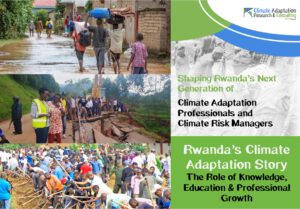 When Martin Rokitzki, Managing Director of PlanAdapt, speaks about climate adaptation, he does not frame it as an environmental issue alone.
For him, adaptation is about people, systems, and survival in a rapidly changing world.
“Climate adaptation is still a new concept,” Rokitzki explains, “yet more than three billion people already need it.”
The numbers come from the Intergovernmental Panel on Climate Change (IPCC), he said, but the reality is visible everywhere—from flooded roads and failing harvests to overstretched health systems and vulnerable urban settlements.
While governments and public institutions provide some support, the majority of people remain underserved.
This gap, he argues, demands a new way of thinking.
Rather than waiting for top-down solutions, Rokitzki believes individuals, communities, companies, and institutions must actively shape their own responses to climate risks.
Farmers, engineers, urban planners, conservationists, bankers—every sector is affected.
Climate adaptation, in his view, is not about saving trees; it is about making roads withstand floods, buildings avoid flood zones, and economies anticipate risk before disaster strikes.
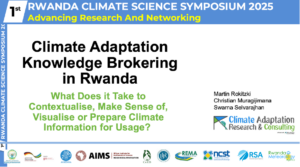
At the heart of PlanAdapt’s mission is a powerful idea: knowledge must be socialized, not siloed.
Too often, climate knowledge is trapped in academic journals, think tanks, and research institutes, serving careers rather than communities.
PlanAdapt wants to change that by democratizing climate knowledge—encouraging people not only to consume information, but to produce it, revise it, and apply it to real-life decisions.
“Adaptation is about anticipation,” Rokitzki says.
“Every system—policy, health, infrastructure, finance—needs to ask how climate change will affect it in an unprecedented future.”
This philosophy is what drives PlanAdapt’s ambition to expand its work to Rwanda.
The organization aims to connect global climate science with local action, especially by working with education institutions such as the University of Rwanda, AIMS, African Leadership University, and others.
The goal is to help build a new generation of professionals who understand climate adaptation as a core skill across sectors.
Rokitzki sees himself as part of the first generation of climate adaptation pioneers.
Having worked in the field for over 20 years—before it was even recognized as a profession—he now feels a responsibility to pass on that knowledge.
Interns and young professionals, he believes, must carry adaptation thinking into construction, finance, governance, and beyond.
This urgency becomes even clearer in a changing global political landscape.
Recent withdrawals of major powers from international climate-related organizations have weakened global cooperation and funding structures.
Rokitzki views this as both a setback and a turning point.
While such withdrawals undermine institutional capacity and shared standards, they also create space for reform, innovation, and new leadership.
For countries like Rwanda, the lesson is not dependency but resilience.
Rwanda benefits greatly from regional and international cooperation, yet its long-term climate strategy cannot rely on uncertain external funding.
The country’s growing intellectual and institutional capacity positions it to lead with homegrown solutions, supported—but not defined—by global systems.
This perspective is echoed by climate researchers and practitioners in Rwanda, including those at Climate Adaptation Research and Consulting (CARC).
Climate Adaptation Research & Consulting (CARC) is a Rwandan organization affiliated with PlanAdapt.
They emphasize that Africa now needs adaptation more than ever.
While some countries produce the bulk of global emissions, African nations disproportionately experience the consequences.
Equity has long been discussed; now action is unavoidable.
Rwanda’s results-based governance model stands out as a continental benchmark.
Accountability, data-driven decision-making, and inter-sectoral collaboration—linking universities, meteorological agencies, policymakers, and local communities—are essential.
Climate policy must be informed by local data and local capacity, even while drawing from global science.
The path forward, they argue, lies in recognizing climate adaptation as a core professional field.
Education systems must integrate it into curricula. Existing professionals must be retrained.
Knowledge must move from graphs and maps into decisions that make sense for a farmer, a business owner, a district, or a community.
In this vision, organizations like PlanAdapt and CARC are not just service providers.
They are ecosystem builders—connecting knowledge, people, and practice across borders and disciplines.
Thinking globally, acting locally, and preparing societies to live with change rather than react to crisis.
Climate adaptation is no longer optional, abstract, or distant.
It is practical, urgent, and deeply human. And in Rwanda, a new story of adaptation—rooted in knowledge, accountability, and local leadership—is already being written.